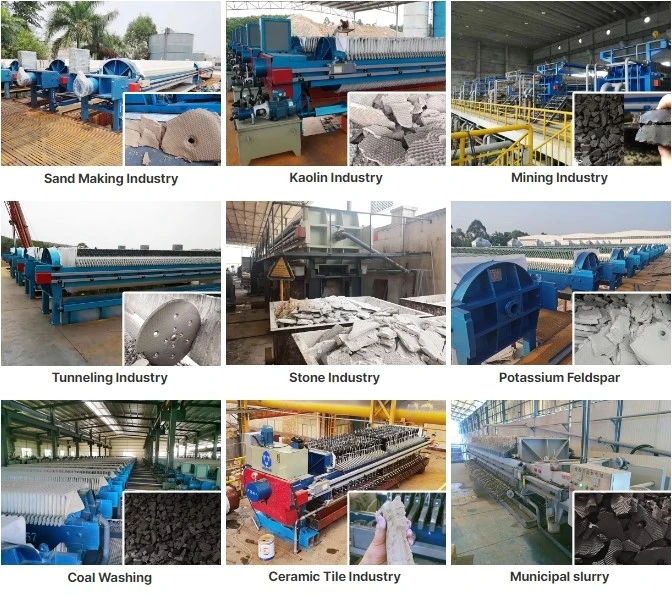
There are three primary types of table filter presses: plate-and-frame filter presses, diaphragm filter presses, and chamber filter presses. Among them, the plate and frame filter press, as a classic solid-liquid separation equipment, is widely used in chemical, environmental protection, food, and other fields due to its simple structure, high filtration pressure, and high solid content of filter cakes. However, its design and working mechanism also determine that it has some inherent disadvantages, which are mainly reflected in the following aspects:
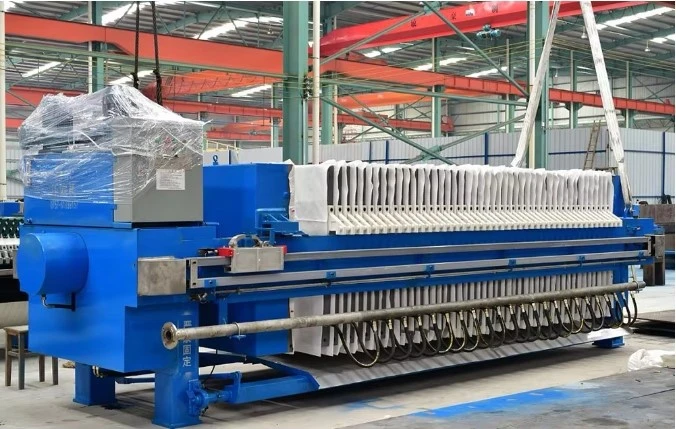
1. Difficult unloading and high labor intensity
The filter unit of the plate and frame filter press consists of alternating filter plates and filter frames, and the filter cake is formed in the filter frame. When unloading, the filter plates need to be pulled apart one by one, and the filter cake needs to be peeled off manually or with the help of simple tools (such as spatulas). Especially when the filter cake is sticky (such as sludge, chemical slurry) or has a high moisture content, it is easy to stick to the filter cloth or filter plate, resulting in incomplete unloading, time-consuming and labor-intensive. Traditional manual equipment even requires the collaboration of multiple people, with a low degree of automation, which does not match the continuity requirements of modern production.
2. The filter cloth is easy to clog, and cleaning and maintenance are frequent.
The filter cloth is the core filter medium of the plate and frame filter press. When it is in contact with solid particles, colloids, or fibrous substances in the suspension for a long time, it is easy to clog (especially fine particles or high-concentration materials). Clogging will lead to a decrease in filtration efficiency and an increase in the moisture content of the filter cake, and frequent shutdowns for cleaning or replacement of the filter cloth are required (generally 1-3 months/time). In addition, the cleaning of the filter cloth consumes a lot of water and chemicals (such as acids and alkalis), which increases operating costs and environmental burdens.
3. Large footprint and heavy equipment.
The filtration area of the plate and frame filter press is determined by the number of filter plates and filter frames. To meet the processing volume requirements, a large number of plates and frames are usually required (for example, a device with a filtration area of 100 square meters may require dozens of sets of plates and frames), resulting in a large size and heavy weight of the equipment (a single device can reach several tons). For factories with limited space (such as small and medium-sized sewage treatment plants), installation and layout will be restricted, and transportation costs are high.
4. Low level of automation and poor operational flexibility
Traditional plate and frame filter presses rely on manual operation (such as manual plate pulling, unloading, and cloth changing), which makes it difficult to achieve continuous production and can only be operated intermittently (each batch of filtration-unloading-assembly cycle is about 0.5-2 hours). Although there is improved equipment with automatic plate pulling and automatic unloading in modern times, the core control logic is still relatively simple, and the adaptability to material characteristics (such as particle size and viscosity) is weak. It is difficult to dynamically adjust the pressure or filtration time according to the working conditions, and the flexibility is insufficient.
5. Many vulnerable parts and high maintenance costs
In addition to the filter cloth, the sealing surface of the plate frame (the contact edge between the filter plate and the filter frame) and the hydraulic system of the clamping device (such as the cylinder and the sealing ring) are also vulnerable parts. Long-term high-pressure operation will cause wear of the sealing surface and leakage of the hydraulic system, which requires regular inspection or replacement (such as 1-2 comprehensive maintenance per year). In addition, if the material of the filter plate (such as cast iron, polypropylene) is not properly selected, it is easy to age and crack in corrosive materials (such as acidic wastewater), further increasing the maintenance cost.
6. The moisture content of the filter cake is limited
Although the plate and frame filter press can achieve a lower moisture content of the filter cake (usually 15%-30%) through high pressure (0.5-1.0MPa), for some ultrafine particles (such as ceramic slurry, lithium battery materials) or colloidal materials (such as printing and dyeing wastewater), solid particles are easy to penetrate the filter cloth or block the pores, making it difficult to further reduce the moisture content of the filter cake (may be higher than 30%), and additional drying equipment (such as hot air drying, centrifugal dehydration) is required, which increases the complexity and cost of the process.
7. Poor adaptability to materials
The filtering effect of the plate and frame filter press is highly dependent on the properties of the material:
*If the material particles are too fine (<1μm) or in a colloidal state (such as protein solution), the filter cloth is easy to clog and the filtering efficiency is greatly reduced;
*If the material is highly corrosive (such as strong acid, strong alkali), corrosion-resistant materials (such as stainless steel, polypropylene) must be used, but the equipment cost will increase.
*If the material contains volatile components (such as organic solvents), high-pressure filtration may cause solvent volatilization, pollute the environment, or cause safety hazards.
Summary
The disadvantages of plate and frame filter presses are mainly low discharge efficiency, frequent maintenance, insufficient automation, and a large footprint. They are more suitable for processing materials with coarse particles, moderate viscosity, and high solid content in filter cakes (such as municipal sludge and mineral processing tailings). In practical applications, it is necessary to compare and select with other dehydration equipment (such as centrifuges, belt filter presses, and screw presses) based on specific working conditions (such as processing volume, material characteristics, and site conditions), or to make up for its limitations through improved designs (such as automatic plate pulling and filter cloth regeneration technology).