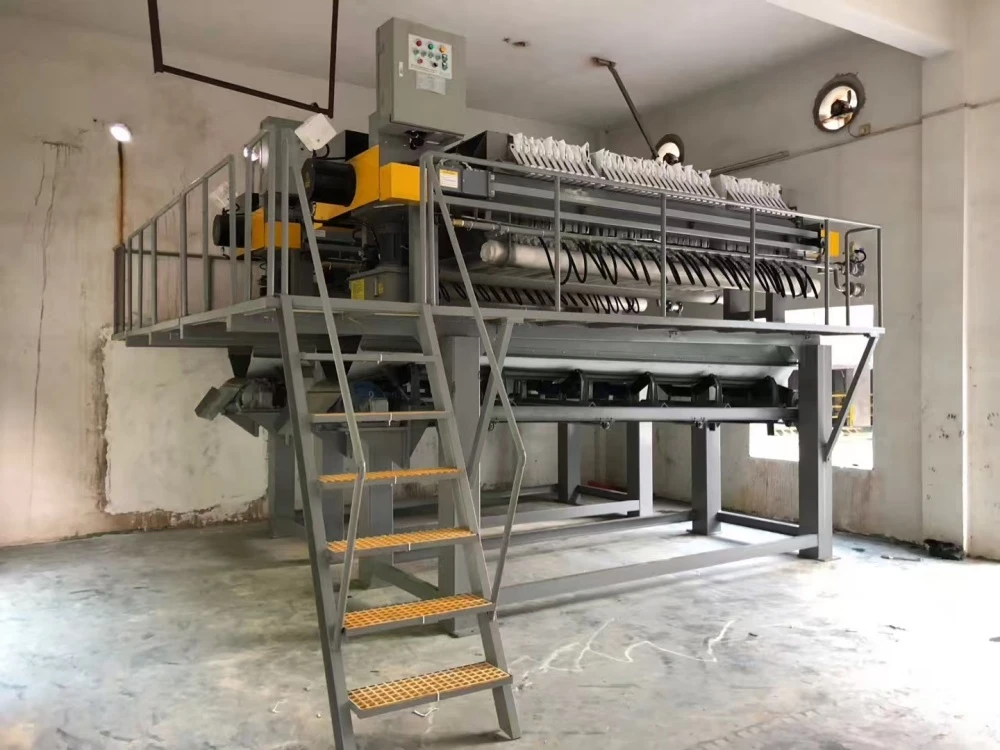
Chamber filter press and diaphragm filter press are common solid-liquid separation equipment, there are obvious differences in structure, working principle and application scenarios, the following are the specific differences:
I. Performance Comparison
|
Comparison Dimension |
Chamber filter press |
Diaphragm filter press |
|
Dehydration efficiency |
Single pressing, filter cake moisture content is about 70-80% |
Second pressing, the filter cake moisture content can be reduced to below 50% |
|
Dehydration method |
Simple pressure filtration |
Pressure filtration + diaphragm extrusion |
|
Typical applications |
Mining, metallurgy, and the general chemical industry |
Sludge treatment, fine chemicals, biomedicine |
|
Applicable materials |
High-concentration, large-particle suspension (such as mining sludge) |
Low-concentration, high-viscosity, fine-particle materials (such as chemical waste liquid) |
|
Energy consumption |
Low (mechanical pressure only) |
High (additional pressing medium required) |
|
Automation degree |
Medium (manual or semi-automatic unloading required) |
High (supports automatic plate pulling, intelligent control) |
|
Maintenance cost |
The Filter plate is easy to wear and needs to be replaced frequently |
The diaphragm has a short life, but the overall structure is more durable |
|
Footprint |
Larger (fixed filter plate spacing) |
Smaller (filter plates can be arranged compactly) |
2. Selection suggestions
* If you need to effectively reduce the moisture content of the filter cake (such as during incineration or landfill pretreatment), or the material has high viscosity and is prone to clogging the filter cloth (such as chemical waste liquid), give priority to the diaphragm filter press.
* If the budget is limited or the material is easy to filter (such as general sludge treatment), the cost of the chamber filter press is higher, while the cost of the diaphragm filter press is lower.